
Technical SEO Services That Remove Barriers to Growth
Find the issues. Fix the foundations. Unlock more of your website's organic potential.
Your website might have valuable content, well-developed service pages, and competitive products. Yet technical issues may prevent search engines from accessing important pages, processing their content correctly, or selecting the intended URLs for indexing.
A misconfigured robots.txt file, problematic JavaScript rendering, inconsistent canonical signals, or poorly planned redirects can affect entire sections of a website.
At Karnaweb, technical SEO is more than identifying errors in an audit report.
We investigate how your website is built, how search engines interact with it, and which technical limitations may be holding back commercially important pages.
By combining SEO knowledge with hands-on web development experience, we connect technical diagnosis with practical implementation.
CTA: Request a Technical SEO Assessment

Could Technical Issues Be Limiting Your Website?
Not every technical SEO problem appears as an obvious error.
Important pages may be missing from Google's index. Crawlers may spend time discovering low-value URL variations. Content that looks correct in a browser may be incomplete in the rendered version processed by search engines.
Common signs worth investigating include:
Important pages unexpectedly excluded from indexing
Large discrepancies between indexable and indexed pages
Google selecting unexpected canonical URLs
Server errors or crawling access problems
Essential content or links missing from rendered pages
Excessive URL variations created by filters and parameters
Organic traffic declines following a website migration or redesign
Significant page performance or mobile usability issues
These symptoms do not automatically indicate a serious SEO failure. We investigate the underlying cause, the scale of the issue, and its potential impact before recommending action.
Our Technical SEO Services
1. Technical SEO Audits and Root-Cause Analysis
A useful technical audit should explain what is happening, why it matters, and what needs to change.
We investigate your website's crawlability, indexability, URL structure, internal links, HTTP responses, technical directives, and the way content is delivered to search engines.
Depending on project access and requirements, our analysis may involve Google Search Console, website crawlers, rendering tests, and server log data.
Rather than treating every automated warning as equally important, we identify patterns and prioritize findings that warrant attention.
Expected deliverable: An actionable assessment identifying issues, affected areas, supporting evidence, priorities, and recommended fixes.
2. Crawling and Indexing Optimization.
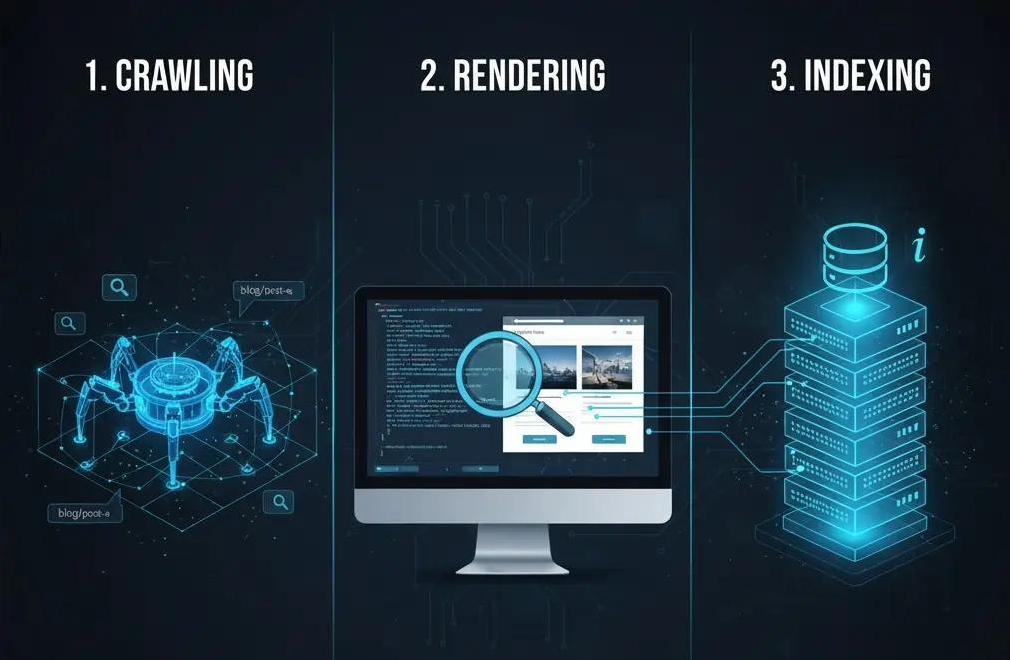
Search engines need to discover and access pages before those pages can become eligible for indexing.
We examine whether important URLs can be crawled, whether technical directives are consistent with their intended purpose, and whether indexable content is being made available appropriately.
Our work may include:
Robots.txt configuration
Noindex directives and X-Robots-Tag headers
HTTP status codes
XML sitemap validation
Internal URL discovery
Page indexing diagnostics
Crawl behavior and server access issues
The goal is not to get every URL indexed.
It is to make the right pages accessible and eligible for indexing while avoiding unnecessary technical obstacles.
For larger websites, we may also investigate crawl patterns and low-value URL spaces when the evidence suggests they are causing operational or discovery problems.
3. Canonicalization and Duplicate URL Management
Multiple URLs containing similar content are common, particularly on ecommerce websites and platforms with dynamic parameters.
Duplicate content is not automatically a penalty. However, inconsistent canonical signals can complicate URL selection and create avoidable technical problems.
We assess:
Incorrect or conflicting canonical tags
Parameter-generated URL variations
Conflicts between redirects and canonical signals
HTTP versus HTTPS and hostname variations
Sorting and filtering URLs
Internal links pointing to nonpreferred URL versions
Depending on the issue, the right solution may involve canonical annotations, redirects, internal linking adjustments, or changes to URL generation.
We recommend changes based on the intended role of the affected pages rather than applying a universal rule to every duplicate URL.
4. JavaScript SEO and Rendering
Modern websites often use JavaScript to load content, generate links, and manage interactive experiences.
Google can render JavaScript, but implementations still need to be tested to ensure that essential content and navigation are available in a form search engines can process.
We investigate issues involving:
Client-side rendered content
Missing or delayed internal links
JavaScript-generated metadata
Content dependent on API responses
Rendering errors
Structured data availability
Server-side rendering and hydration where relevant
The right approach depends on your framework, infrastructure, and the symptoms identified.
We don't recommend replacing a website's rendering architecture simply because it uses JavaScript. We establish whether a real accessibility or rendering problem exists first.
5. Core Web Vitals and Website Performance
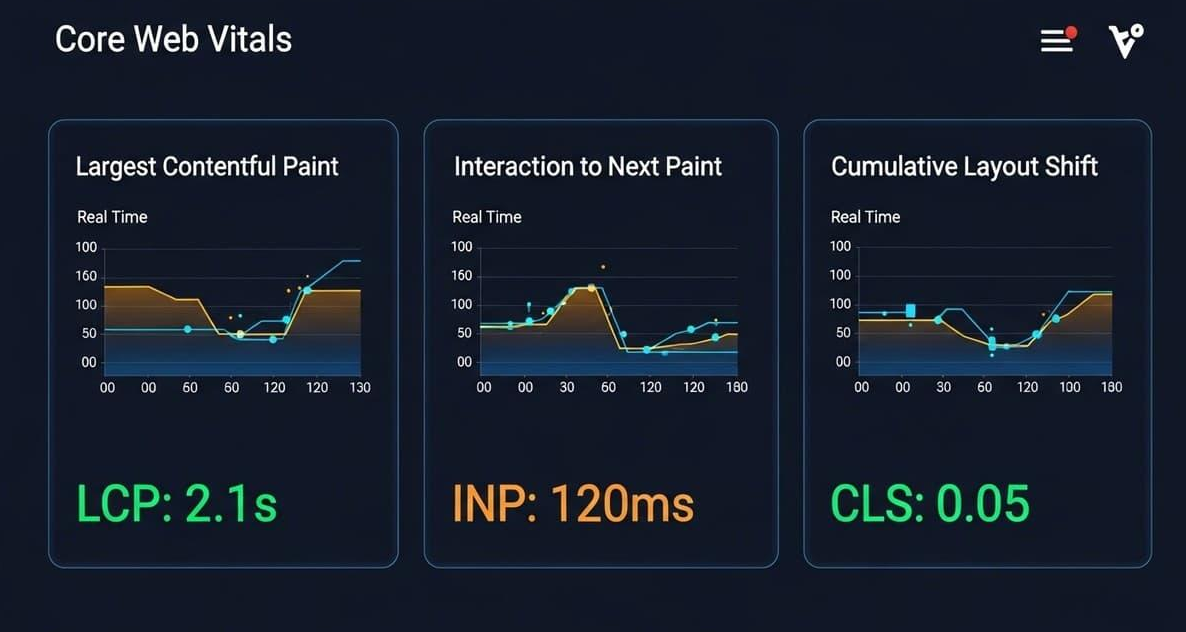
A website should perform reliably for the people using it, not just look good in a testing tool.
We investigate technical factors affecting loading performance, responsiveness, and visual stability.
Our Core Web Vitals work focuses on:
Largest Contentful Paint (LCP)
How quickly the largest visible content element appears during page loading.
Interaction to Next Paint (INP)
How responsive the page is to user interactions.
Cumulative Layout Shift (CLS)
How much visible content shifts unexpectedly as the page loads and users interact with it.
Depending on the findings, improvements may involve image delivery, JavaScript execution, CSS, font loading, caching, or server performance.
We distinguish laboratory measurements from real-user field data and prioritize issues according to user impact and implementation effort.
A perfect PageSpeed score is not the objective. A faster, more stable, more usable website is.
6. Website Architecture and Technical Internal Linking
A website's structure influences how easily users and crawlers can reach important content.
We evaluate the technical organization of pages and the links connecting them.
This may include:
Website hierarchy and URL structure
Navigation and crawlable links
Orphan pages
Broken internal links
Excessive URL depth
Category and product relationships
Internal redirect chains
Important pages with inadequate internal links
We aim to improve discoverability while preserving intuitive navigation and a logical information architecture.
Technical changes should support the way visitors use your website, not work against it.
7. Structured Data and Schema Validation
Structured data provides machine-readable information about eligible page content and entities.
We review whether structured data is technically valid, accurately represents the visible page, and follows the requirements of the relevant search features.
Our work can include validating existing markup, investigating errors, and implementing appropriate supported types.
Correct structured data does not guarantee a rich result, nor does adding more schema automatically improve rankings.
The objective is accurate, maintainable implementation.
8. Ecommerce Technical SEO
Ecommerce websites often combine large product catalogs, dynamic filtering, changing inventory, and multiple URL variations.
These features can introduce technical challenges that differ from those of a conventional business website.
We examine areas such as:
Faceted navigation and filter URLs
Parameter handling
Product and category indexability
Duplicate or near-duplicate pages
Out-of-stock and discontinued product URLs
Pagination and crawlable navigation
Product structured data
Category architecture and internal linking
Our approach considers both organic search requirements and the shopping experience.
The objective is a scalable technical structure that supports product discovery without unnecessarily complicating navigation or index management.
9. SEO Website Migrations
A migration can involve changing domains, content management systems, site architecture, templates, or URL structures.
Without appropriate planning, these changes can introduce technical problems that affect existing search visibility.
We support migration planning and validation through activities such as:
Pre-migration technical assessment
URL inventory and mapping
Redirect strategy and testing
Staging environment checks
Canonical and indexing directive validation
Internal link and sitemap updates
Post-launch crawling and indexing monitoring
Our goal is to reduce avoidable risks and identify problems early.
No migration can be promised to preserve every existing ranking or traffic level, but careful preparation and monitoring can help manage the transition.
10. International and Multilingual Technical SEO
Websites serving different languages or regional audiences need a clear technical structure.
We evaluate whether language and regional versions are implemented consistently and can be discovered and interpreted appropriately.
Depending on the project, this includes:
Language-specific URL architecture
Hreflang annotations
Self-referencing and reciprocal language relationships
Canonical consistency
Redirect behavior
XML sitemap implementations
Technical checks for localized content
We align technical recommendations with the actual languages, regions, and business markets your website serves.

Why a Technical SEO Audit Alone Isn't Enough
Automated SEO tools can identify hundreds or even thousands of warnings.
But a long list of issues does not explain which ones are preventing meaningful progress.
A minor warning on an unimportant page may have little business relevance. A single indexing directive affecting a critical product category could require urgent investigation.
Some problems can be addressed through configuration changes. Others require adjustments to templates, application logic, URL handling, or server infrastructure.
That's why we connect three essential activities.
Diagnose the Root Cause
We investigate technical behavior and supporting evidence instead of relying entirely on tool-generated severity labels.
Prioritize What Matters
We consider the number and importance of affected pages, the scale of the issue, expected benefits, implementation risk, and development effort.
Turn Findings Into Action
We translate validated findings into technical requirements and practical fixes.
Depending on the engagement, this may involve direct implementation or collaboration with your existing development team.
The value of technical SEO is not the number of errors reported. It's the quality and impact of the problems resolved.
Our Technical SEO Process
Step 1: Understand Your Website and Objectives
We review the technology stack, website scale, commercial priorities, known issues, and recent changes.
This establishes the context needed to distinguish critical problems from expected technical behavior.
Step 2: Investigate and Validate
We examine representative URLs, recurring patterns, search engine reports, and technical evidence.
The aim is to understand why a problem occurs rather than simply identifying where it appears.
Step 3: Build a Prioritized Technical Roadmap
We organize recommendations according to severity, affected pages, business relevance, dependencies, and implementation effort.
This gives your team a clearer understanding of what should happen first.
Step 4: Implement and Test
We work on agreed changes or collaborate with your technical team.
Where appropriate, changes are tested before release, followed by checks for regressions and unintended side effects.
Step 5: Verify and Monitor
We check whether the intended technical behavior has been achieved and monitor the relevant crawling, indexing, and performance indicators over time.
Search engines may take time to recrawl and process changes, so implementation and observed search outcomes are evaluated separately.
How We Prioritize Technical SEO Issues
| Priority | Example | Why It Matters |
|---|---|---|
| Critical | Important commercial pages unintentionally blocked from indexing | Affects eligibility for search visibility |
| High | Incorrect canonical templates or missing primary rendered content | May affect entire groups of important pages |
| Medium | Significant performance issues on key landing pages | Can reduce usability and page experience |
| Context-dependent | Minor schema warnings or low-impact technical alerts | May have limited value relative to the effort required |
These are illustrative categories, not automatic classifications.
Actual priority depends on evidence, website context, and business impact.
Who Benefits From Technical SEO Services?
Our technical SEO services are relevant to:
Large websites with complex architecture
Ecommerce stores with extensive product catalogs
Custom-built and JavaScript-heavy websites
Businesses experiencing persistent crawling or indexing issues
Websites preparing for migration or major redesign
Multilingual and international websites
Teams that need help implementing the findings of a previous SEO audit
Whether your website has a specific technical problem or requires a broader assessment, we start by establishing what the evidence supports.
Frequently Asked Questions
What is the difference between SEO and technical SEO?
SEO covers the broader strategy for improving organic search performance, including search intent, content, on-page optimization, and measurement.
Technical SEO focuses on how a website is built and delivered, including crawling, indexing, rendering, URL management, performance, and other technical requirements.
Will fixing technical SEO issues improve my Google rankings?
Not necessarily.
Resolving technical issues can remove obstacles that prevent search engines from accessing or understanding important content.
Rankings also depend on relevance, content quality, competition, and other factors. Technical improvements should be assessed according to the specific issues they address.
Should every page on my website be indexed?
No.
Not all URLs provide independent value in search results. Internal search pages, duplicate variants, and some functional URLs may not need to be indexed.
The appropriate strategy depends on the purpose of the pages and the website's architecture.
Do I need a perfect PageSpeed Insights score?
No.
PageSpeed Insights provides useful diagnostic information, but a perfect laboratory score is not a requirement for good SEO.
We focus on real-world performance, usability, and measurable improvements rather than optimizing a number in isolation.
Does technical SEO require rebuilding my website?
Usually not.
Many technical problems can be addressed through configuration, template, code, or structural changes within the existing platform.
A larger rebuild should only be considered when the current architecture creates fundamental limitations that cannot reasonably be addressed.
Can you work with our existing development team?
Yes. Depending on the agreed scope, technical SEO work can involve diagnosis, implementation guidance, coordination with developers, and validation of completed fixes.
How long does a technical SEO project take?
The duration depends on website size, technology, the severity of issues, and access to development resources.
A focused indexing problem may require a very different scope from a complex ecommerce migration or sitewide architecture review.
Do you provide technical SEO audits without ongoing SEO management?
A focused assessment can be defined as a separate engagement, with any subsequent implementation or monitoring scoped according to the findings and agreed requirements.
Build a Stronger Technical Foundation for Organic Growth
Your website may be losing search opportunities because of issues that aren't obvious from a ranking report or a standard traffic dashboard.
Understanding those issues is the first step. Resolving the right ones is what turns technical analysis into meaningful progress.
At Karnaweb, we connect technical SEO, web development, and performance analysis to help businesses build websites that are easier to maintain, improve, and grow.
Final CTA: Request a Technical SEO Assessment