
Local SEO Services for Business Growth | Karnaweb
Local SEO Services That Connect Your Business With Nearby Customers
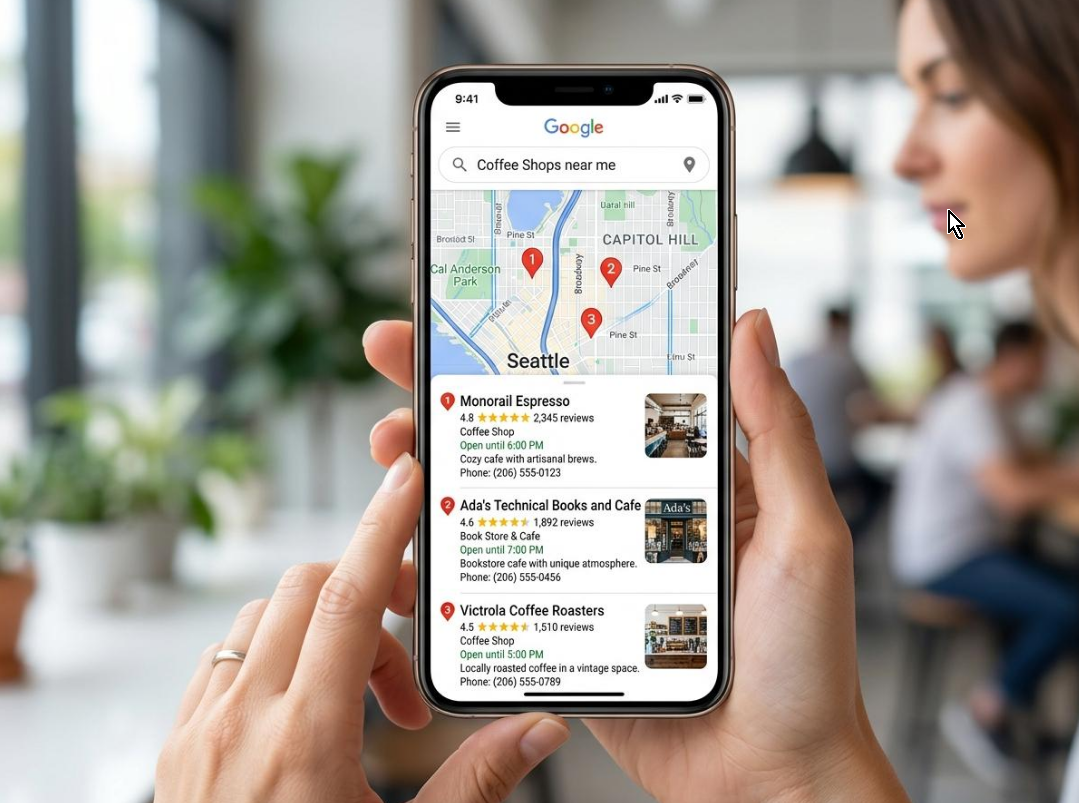
Be easier to find, easier to trust, and easier to choose when local customers need what you offer.
When someone searches for a nearby service, a local business, or a provider in a specific area, they are often looking for a practical next step.
They may want to call, compare providers, book an appointment, request a quote, or visit a location.
But being present in local search results is only part of the opportunity. Customers also need accurate information, clear service descriptions, trustworthy signals, and a simple path to take action.
At Karnaweb, we approach Local SEO as a connected customer acquisition strategy.
We bring together local search visibility, Google Business Profile optimization, location-focused website content, user experience, and performance measurement to help businesses make more of relevant local demand.
Our objective is not simply to increase map impressions. It is to help create meaningful opportunities for customer enquiries, appointments, visits, and sales.
CTA: Explore Your Local Growth Opportunities
Why Local Search Visibility Matters
Imagine someone searching for a clinic, training center, home service provider, or professional service in their area.
They may already know what they need. Their next decision is which business to contact.
Several questions influence that choice:
Can they find a business offering the service they need?
Is its location or service area clear?
Are its hours and contact details accurate?
Does its website explain the service well?
Can they evaluate customer feedback and relevant credentials?
Is it easy to call, request a quote, or make an appointment?
An effective local search strategy considers this entire decision-making process.
Local visibility also depends on factors outside a business's direct control, including the searcher's location and the competitive landscape.
That's why we focus on relevant visibility and customer actions rather than guaranteeing a fixed map ranking across an entire city.
Our Local SEO Services
1. Local Search Research and Opportunity Analysis
Before making changes, we need to understand how customers search in the areas your business actually serves.
We investigate service-related queries, location intent, local search results, competing businesses, and the types of pages appearing for relevant searches.
This includes searches that explicitly mention a city or neighborhood, as well as searches where Google interprets local intent without a location name.
Our findings help identify:
Services with meaningful local demand
Relevant geographic markets
Gaps in existing search visibility
Opportunities for service and location pages
Competitive strengths and weaknesses
Priorities for website and profile improvements
The goal is to build an informed local search strategy based on real customer needs.
2. Google Business Profile Optimization
For eligible businesses, Google Business Profile provides an important way to manage information displayed across Google Search and Maps.
We evaluate whether the profile accurately represents the business and provides useful information for potential customers.
Depending on the profile and the agreed scope, optimization may include:
Primary and secondary business categories
Accurate business name and contact information
Physical location or service area settings
Opening hours and special hours
Relevant services and business descriptions
Authentic business photography
Website landing page selection
Profile completeness and consistency
Investigation of verification or visibility issues
All recommendations must reflect the business's real-world operations and Google's eligibility requirements.
We do not recommend keyword-stuffed business names, fictitious locations, or misleading business information.
3. Local Landing Pages and Website Optimization
A business profile may help people discover your company, but your website often plays a central role in their final decision.
Potential customers may need more information about services, qualifications, pricing approaches, locations, availability, and the process of working with you.
We evaluate and improve commercially important website pages to help visitors understand what you offer and how to get in touch.
This may involve:
Location-relevant service content
Dedicated pages for genuine business locations
Clear location and contact information
Useful directions and practical access details
Service-specific questions and answers
Relevant trust signals
Internal linking and navigation
Mobile-friendly contact and appointment journeys
We don't recommend creating large numbers of nearly identical city pages simply to target different geographic keywords.
Each page should serve a distinct, useful purpose for the people it is intended to reach.
4. Business Information Consistency and Local Citations
Customers may encounter your business through search results, directories, industry platforms, and other local information sources.
When names, addresses, phone numbers, or operating details conflict, customers can become confused or lose confidence.
We identify important sources of business information and assess where corrections or updates are worthwhile.
Our approach favors accurate, relevant listings over mass submissions to low-quality directories.
The priority is consistency where customers are likely to look for your business, not accumulating citations for their own sake.
5. Review Strategy and Local Reputation Signals
Customer reviews can help people evaluate a business before contacting it.
They may also contribute to local search prominence.
We help businesses establish practical approaches to requesting genuine feedback and responding professionally to customer reviews.
This can include:
Improving the process for requesting honest customer feedback
Identifying appropriate points in the customer journey
Establishing consistent response guidelines
Monitoring recurring themes in customer feedback
Connecting review insights with service improvements
We do not support fabricated reviews, purchased ratings, or incentives conditioned on positive feedback.
A sustainable local reputation should reflect real customer experiences.
6. Multi-Location SEO
Businesses operating from several genuine locations need a structured approach to local search.
Each branch may have distinct contact details, opening hours, staff, services, and local customer needs.
A useful multi-location strategy should preserve a consistent brand experience without losing the practical information customers need for each location.
Our work may cover:
Location page architecture
Branch-specific website content
Google Business Profile consistency
Local navigation and internal linking
Contact and conversion paths by location
Location-level performance measurement
Processes for maintaining business information
The appropriate setup depends on how the locations operate and whether they meet the relevant platform eligibility requirements.
7. Local SEO for Service-Area Businesses
Not every local business serves customers at a storefront.
Plumbers, home maintenance providers, cleaning services, and many other businesses travel to customers.
For eligible service-area businesses, Google Business Profile settings and website content should reflect how services are actually delivered.
We assess the real service area, customer search behavior, relevant services, and the structure of website pages.
Where appropriate, we help align profile settings with the business's actual operating model.
Defining a service area does not mean a business will rank equally throughout that entire area.
8. Local Technical SEO and Structured Data
Local search performance can also be affected by the underlying website experience and implementation.
We examine relevant technical elements, including:
Crawlable location and service pages
Logical website architecture
Mobile usability
Clear contact information
Internal linking
Structured business information
Relevant LocalBusiness schema markup
Structured data can help search engines interpret business details, but it does not guarantee rich results or higher local rankings.
Technical recommendations are selected according to the actual website and business requirements.
9. Local SEO Analytics and Performance Measurement
Visibility metrics are useful, but they do not always explain whether local search activity is contributing to customer acquisition.
We work to connect available local search data with meaningful customer interactions.
Depending on the business and its tracking setup, relevant indicators may include:
Local search visibility
Google Business Profile interactions
Website visits from relevant searches
Calls and enquiry submissions
Direction requests
Appointment bookings
Qualified leads
Location-specific conversions
Measurement is only as useful as the data supporting it.
Where offline visits or phone enquiries cannot be reliably attributed to a particular channel, we make those limitations clear rather than presenting estimates as confirmed results.
Why Google Maps Optimization Alone Isn't Enough
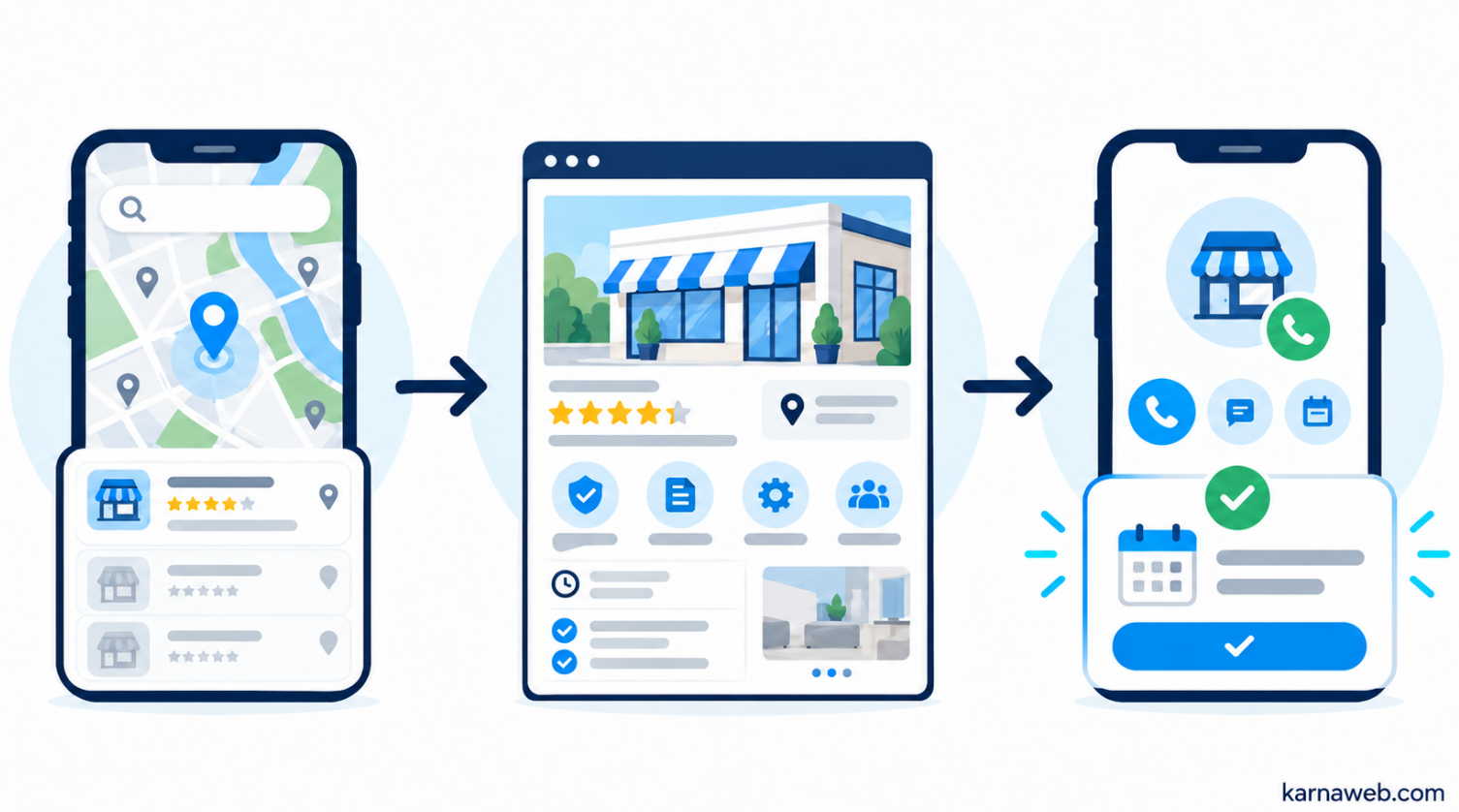
A business may have a complete Google Business Profile but a website that leaves important customer questions unanswered.
Another business may attract visitors from local search but make it difficult to find its phone number, book an appointment, or request a service.
These are different problems, but they affect the same customer journey.
At Karnaweb, we connect three areas of local customer acquisition.
Get Discovered
Make it easier for relevant customers to encounter accurate business information and useful location-related content.
Build Confidence
Help visitors understand your services, operating areas, credentials, and customer experience.
Encourage Meaningful Action
Reduce unnecessary friction between finding the business and contacting, visiting, or booking with it.
This approach recognizes that better visibility only creates business value when customers can move forward with confidence.
Our Local SEO Process
Step 1: Understand Your Business and Locations
We begin with your services, customer needs, operating model, geographic coverage, and commercial priorities.
A single-location business, multi-location company, and service-area provider may require different strategies.
Step 2: Evaluate Your Existing Local Presence
We review relevant local search results, website pages, available business profile information, and competitive conditions.
The assessment identifies gaps, inconsistencies, and potential opportunities.
Step 3: Develop a Prioritized Roadmap
We organize recommendations around business relevance, potential value, implementation effort, and operational requirements.
This creates a plan that fits the business rather than a generic local SEO checklist.
Step 4: Implement Improvements
Depending on the agreed engagement, we work on business profile optimization, website content, location architecture, technical issues, and the local conversion experience.
Where necessary, we coordinate changes with the business's existing team.
Step 5: Measure, Learn, and Refine
We review available data, evaluate completed changes, and identify the next practical improvements.
As your business expands, changes locations, or introduces new services, your local search strategy may need to evolve as well.
Which Businesses Benefit From Local SEO?
Our approach is relevant to businesses that serve customers in defined geographic markets, including:
Healthcare and professional service practices
Training centers and educational businesses
Home services and maintenance providers
Retail stores and showrooms
Legal, consulting, and other professional service firms
Businesses operating within service territories
Brands with multiple physical locations
The balance between map visibility, organic location pages, and website conversion optimization will vary.
Not every business needs every component of local SEO, and not every business is eligible for a Google Business Profile.
How We Measure Local SEO Success
| Performance Area | What We Evaluate |
|---|---|
| Local Search Visibility | Presence across relevant local searches |
| Business Profile Performance | Available interactions with the business profile |
| Local Website Traffic | Visits to relevant service and location pages |
| Leads and Enquiries | Tracked calls, forms, and customer requests |
| Bookings and Visits | Observable customer actions where measurement is available |
| Lead Quality | Relevance of enquiries to actual services |
We also distinguish between leading indicators, such as visibility, and business outcomes, such as qualified enquiries.
Offline activity and platform reporting limitations can make attribution incomplete. Our reporting should reflect those uncertainties.
Frequently Asked Questions
What is the difference between SEO and local SEO?
General SEO focuses on improving a website's presence for relevant organic searches.
Local SEO focuses on search behavior where geographic relevance plays an important role, including location-based organic results and eligible business profiles shown in Google Search and Maps.
Can a business without a storefront benefit from local SEO?
Yes, depending on how it operates.
Businesses that genuinely travel to serve customers may qualify for a service-area Business Profile. Purely online businesses and virtual offices do not automatically qualify.
Location-relevant website optimization may still be useful even when a business is not eligible for a Google Business Profile.
Can you guarantee a top-three Google Maps ranking?
No.
Local results depend on several factors, including relevance, distance, and prominence.
Results can change based on the searcher's location and query, so no responsible provider can guarantee a fixed position everywhere.
Do we need a separate page for every city or neighborhood?
Not necessarily.
Dedicated pages can be helpful when they provide meaningful, distinct information about real locations or services.
Creating many near-identical pages with only the location name changed is not a sound long-term strategy.
Do customer reviews affect local search visibility?
Google identifies reviews and ratings among the signals related to local prominence.
Reviews also provide information that may influence customer decisions. We recommend seeking authentic feedback and maintaining a professional response process.
How long does local SEO take to work?
There is no universal timeline.
Results depend on your starting position, competitive environment, business location, website quality, and the changes implemented.
Some updates may become visible relatively quickly, while broader improvements require ongoing evaluation.
Can you support businesses with multiple locations?
Our proposed service scope includes multi-location planning, location pages, business information consistency, and location-specific measurement.
Implementation responsibilities and reporting requirements are defined according to the number and complexity of locations involved.
How much do local SEO services cost?
Pricing depends on your existing local presence, number of locations, competition, content requirements, technical needs, and implementation scope.
An initial assessment helps determine which activities are necessary and what level of engagement makes sense.
Turn Local Searches Into Meaningful Business Opportunities
When potential customers look for services in the areas you serve, your digital presence should help them discover your business, understand what makes it relevant, and take the next step.
At Karnaweb, we combine local search strategy, website optimization, customer experience, and performance analysis to support ongoing local business growth.
Final CTA: Let's Explore Your Local Growth Opportunities